Croatia – a small country with a great sporting tradition
Croatia is one of the best examples of a country that, despite its relatively small population, has consistently achieved results at the highest international level. This applies primarily to football, but also to handball, basketball, tennis, water polo, rowing and combat sports.
In the UEFA country ranking, Croatia is positioned around the beginning of the third ten. It is surrounded by countries such as Scotland, Austria, Romania and Serbia. This position allows several Croatian clubs to enter European competitions, although most of them have to begin their campaigns in the qualifying rounds.
Great talent from a small country
Croatia has a relatively small football market, but for decades it has produced players of outstanding sporting quality. Luka Modrić, Zvonimir Boban, Davor Šuker, Ivan Rakitić, Mario Mandžukić and Mateo Kovačić are just some of the names that have become well known in Europe's biggest leagues.
The Croatian national team has won medals at the World Cup in several different eras. The team reached the final of the 2018 World Cup in Russia and, several years later, finished on the podium at the tournament in Qatar. Croatians have also won medals at European championships in other sports, while the success of the national football team has repeatedly led the country to be regarded as a sporting power disproportionate to its size.
The secret behind Croatia's success is a combination of technical training, a strong sporting culture and the important role played by smaller clubs. Many players began their careers at local academies before moving to Dinamo Zagreb, Hajduk Split or clubs abroad.
Dinamo Zagreb – the clear leader
The most important club in Croatia is Dinamo Zagreb. It provides the overwhelming majority of the country's coefficient points and regularly appears in the league phases of the Champions League, Europa League or Conference League.
In the UEFA club ranking, Dinamo is positioned around 50th, clearly ahead of the other Croatian teams. The club has enjoyed many seasons in the group or league phases of European competitions and, over the past decade and a half, has very frequently represented Croatia at the highest level.
Dinamo have not won the Champions League or Europa League, but they have recorded numerous notable campaigns. The club has reached the quarter-finals and semi-finals of former European competitions and, in the 21st century, has regularly faced teams from England, Spain, Germany and Italy.
One of the most memorable victories came against Tottenham Hotspur in the Europa League. Dinamo lost the first leg, but came from behind in the return match, won after extra time and advanced to the next round. Matches such as this have strengthened the club's reputation as Croatia's most dangerous representative in Europe.
The rest of the clubs lag behind
Although Croatia has several historic clubs, the gap between Dinamo and the rest is very significant. Hajduk Split, Rijeka, Osijek and Varaždin have tradition, supporters and ambition, but they are not able to progress through qualifying rounds or reach league phases as consistently.
In the UEFA club ranking, Dinamo is well ahead of Hajduk, Rijeka and the other Croatian teams. Over the five seasons under review, the Zagreb club has earned by far the most points for the country, while the other representatives have produced much more inconsistent results.
Hajduk Split remains one of the most recognisable clubs in the Balkans, but most of its European successes belong to earlier decades. In recent years, Rijeka has managed to reach the group stages of European competitions, but has not yet established a stable position at Dinamo's level.
Osijek and Varaždin have potential, but usually exit at earlier stages. This means that even when Dinamo performs well, Croatia does not always receive enough support from its other clubs.
Dinamo as a talent factory
Dinamo Zagreb is not only Croatia's most important club, but also one of the best football academies in Europe. Players developed by the club include Modrić, Boban, Šuker, Eduardo da Silva, Vedran Ćorluka, Marcelo Brozović and Joško Gvardiol.
Dinamo's model is relatively straightforward: the club identifies talented players, develops them, gives them opportunities in the first team and then sells them to wealthier leagues. Transfer income provides resources for the continued development of the academy and helps the club maintain its advantage over domestic rivals.
This benefits the Croatian national team, but also has a negative consequence for the domestic league. The best players often leave relatively quickly, before they have spent many years playing in the Croatian top flight. The league loses its stars, but the country gains players competing at the highest level in England, Spain, Italy and Germany.
Hajduk Split – the great rival
Dinamo's biggest rival is Hajduk Split. The rivalry between the two clubs is one of the most important derbies in Southeastern Europe. Dinamo represents the capital and northern part of the country, while Hajduk is strongly associated with Split, Dalmatia and the Adriatic coast.
Hajduk has a huge fan base and a unique atmosphere at Poljud Stadium. The club currently cannot match Dinamo in terms of consistency, but it remains extremely important to Croatian football identity.
Interestingly, Hajduk was founded in Prague by a group of students from Dalmatia. The name "Hajduk" refers to the Balkan outlaws and rebels who, in local tradition, were portrayed as opponents of foreign authorities.
Rijeka and European surprises
Rijeka is one of the clubs that have tried to challenge Dinamo's dominance in recent years. The team's greatest success came with winning the Croatian championship and reaching the Europa League group stage.
The club from Rujevica Stadium has a smaller financial base than Dinamo, but has been able to make effective use of stable management, good organisation and an efficient transfer policy. Rijeka regularly appears in qualifying rounds, although it has found it difficult to remain in European competitions for several consecutive seasons.
Croatia in European competitions
Croatia has not won the Champions League or Europa League. The country's greatest club achievements belong to Dinamo, which has reached the advanced stages of former European competitions, as well as several strong campaigns by Hajduk, Rijeka and other teams.
Dinamo remains the only Croatian club capable of regularly reaching the Champions League league phase. In recent years, it has faced teams such as Chelsea, Milan, Manchester City, Arsenal and other major European clubs.
Dinamo's victory over Chelsea in Zagreb and its triumph over Tottenham in the Europa League are particularly memorable. Such results demonstrate that the club can defeat considerably wealthier opponents, especially at home.
A small league with big ambitions
Croatia is positioned around the beginning of the third ten in the UEFA ranking and remains one of the more important mid-level European countries. Dinamo provides regular representation in European competitions, but the other clubs are not yet able to contribute a comparable number of points.
The biggest challenge is reducing the dependence on a single team. If Hajduk, Rijeka, Osijek and Varaždin reach league phases more frequently, Croatia could improve its position in the ranking. For now, however, the gap between Dinamo and the rest remains very significant.
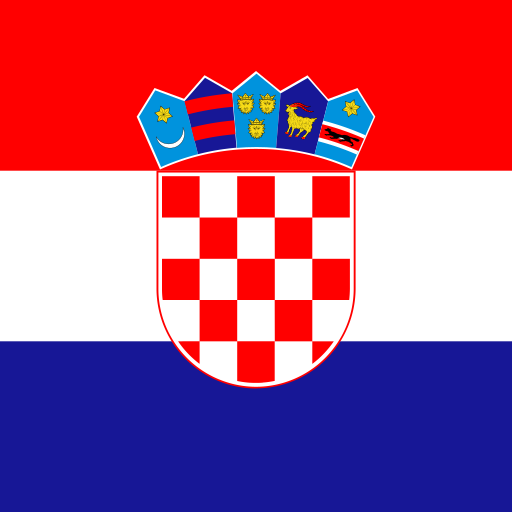 Croatia