Coefficient:
7.250 2025/26
Ranking position:
47 2025/26
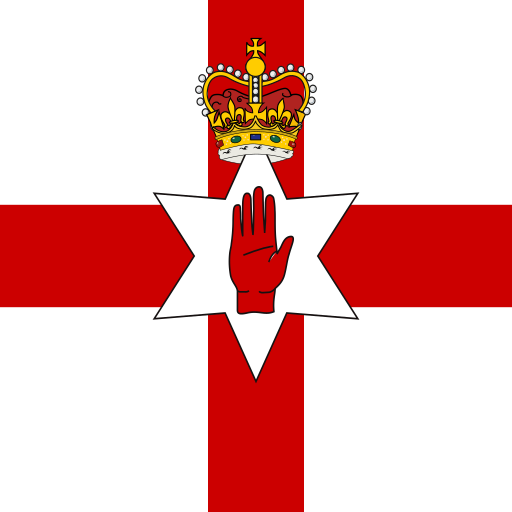 Northern Ireland
Northern Ireland has 4 representatives in European competitions in the 2026/27 season: Larne FC, Glentoran FC, Coleraine FC, Linfield FC thanks to its 42nd place finish in the UEFA association coefficient ranking.
| Country | 2022/23 | 2023/24 | 2024/25 | 2025/26 | 2026/27 | Total | Difference | |||
|---|---|---|---|---|---|---|---|---|---|---|
| 47 |
 |
Malta | 2.625 | 1.500 | 1.000 | 2.000 | 0.500 | 7.625 | -1.000 | Countries comparison: Northern Ireland - Malta |
| 48 |
 |
Gibraltar | 0.875 | 0.166 | 1.500 | 3.333 | 1.333 | 7.207 | -0.582 | Countries comparison: Northern Ireland - Gibraltar |
| 49 |
 |
Estonia | 1.166 | 0.125 | 1.625 | 1.625 | 2.500 | 7.041 | -0.416 | Countries comparison: Northern Ireland - Estonia |
| 50 |
|
Northern Ireland | 1.250 | 1.125 | 1.500 | 1.750 | 1.000 | 6.625 | – | |
| 51 |
 |
Georgia | 1.125 | 1.250 | 1.250 | 1.125 | 1.750 | 6.500 | +0.125 | Countries comparison: Northern Ireland - Georgia |
| 52 |
 |
Luxembourg | 1.125 | 2.250 | 1.250 | 0.750 | 0.875 | 6.250 | +0.375 | Countries comparison: Northern Ireland - Luxembourg |
| 53 |
 |
Montenegro | 1.000 | 1.333 | 2.500 | 1.000 | 0.000 | 5.833 | +0.792 | Countries comparison: Northern Ireland - Montenegro |
Northern Ireland is 0.125 points ahead of 51st place (Georgia) and 0.416 points behind 49th place (Estonia).
| 2022/23 | 2023/24 | 2024/25 | 2025/26 | 2026/27 | Total |
|---|---|---|---|---|---|
| 1.250 | 1.125 | 1.500 | 1.750 | 1.000 | 7.250 |
Over the past five years, the country Northern Ireland has earned a total of 6.625 points in the UEFA competitions. Its best season was 2025/26, when it earned 1.750.
Northern Ireland is one of the most unusual federations in European football. It is not an independent state but part of the United Kingdom, yet it has its own national team and separate membership of UEFA and FIFA.
In the UEFA country ranking, Northern Ireland is currently around 50th place. It is close to Estonia, Gibraltar, Georgia and Luxembourg. The differences between these federations are small, so one successful season can significantly improve a position, while several early exits from qualifying can lead to a decline.
The most successful club in Northern Ireland is Linfield FC from Belfast. For many years, the club has been one of the country’s most frequent representatives in European competitions and has by far the richest history among Northern Irish teams.
Linfield are the only Northern Irish club to have reached the quarter-finals of the European Cup. They achieved this in the 1966/67 season after eliminating teams from Luxembourg and Norway. In the quarter-finals, they lost to Bulgarian side CSKA, but the achievement remains the club’s best result in UEFA’s premier competition.
Today, Linfield regularly begin their European campaigns in Champions League qualifying. If they fail to progress, they often enter the Europa League or Conference League qualifying rounds. Their experience and favourable seeding make them the most important source of points for Northern Ireland.
The club plays its home matches at Windsor Park in Belfast, which is also the main stadium of the national team. The venue has a rich history and is one of the country’s most important sporting landmarks.
In recent years, Linfield’s most serious rival has become Larne FC. The club from the port town on the eastern coast has made a rapid journey from a team fighting for domestic recognition to a regular participant in European qualifying.
Larne became the first club from the Northern Irish Premiership to reach the league phase of a European competition. Its achievement in the Conference League was a breakthrough for Northern Irish football, showing that a club from outside Belfast could progress through several rounds and compete with teams from larger leagues.
In European campaigns, Larne have benefited from good organisation, a stable squad and growing experience. The club does not have Linfield’s history, but in recent seasons it has contributed more than any other side to improving Northern Ireland’s image in European football.
Larne’s geography is also noteworthy. The town lies on Belfast Lough and has long been an important port. The club has therefore become a sporting symbol of a region traditionally associated more with maritime transport and industry than with European football.
Crusaders FC are another important Belfast club. The team regularly participates in European qualifying rounds, although its campaigns usually end at an early stage. Crusaders nevertheless have a strong position in the domestic league and a loyal following.
Cliftonville are one of the oldest football clubs on the island of Ireland. Based in north Belfast, the club has particular significance in the local history of the sport. Cliftonville frequently compete against Linfield, Crusaders and Glentoran, and matches between these teams form the foundation of Northern Ireland’s football scene.
Glentoran represent east Belfast and are one of the country’s most historic clubs. Their most notable European performance came against Benfica in the 1967/68 European Cup. Glentoran drew at home against the Portuguese giants and then secured a goalless draw in Lisbon. Benfica advanced under the away-goals rule, but Glentoran made history as the first club to prevent Benfica from scoring at home in a European competition.
Football in Northern Ireland is closely connected with the history of the conflict between supporters of remaining part of the United Kingdom and Irish nationalists who favour the unification of the island. These divisions influenced clubs, stadiums, supporters and national teams for many years.
Linfield and some other clubs have traditionally been associated with the Protestant and unionist community. Cliftonville, on the other hand, has stronger links with the Catholic and nationalist community. Modern football seeks to reduce the importance of these divisions, but their historical background remains present in supporter culture.
The Northern Ireland national team plays under its own symbols, anthem and colours. At the same time, people in the region may identify as British, Irish, Northern Irish, or as a combination of these identities.
This also affects players’ international choices. People born in Northern Ireland may, subject to FIFA eligibility requirements, represent either Northern Ireland or the Republic of Ireland. This is a consequence of the right to British or Irish citizenship confirmed by the Good Friday Agreement.
The greatest achievement of the modern Northern Ireland national team was qualification for the 2016 European Championship. It was the team’s first appearance in the finals of the tournament, and Northern Ireland subsequently reached the round of 16.
Northern Ireland became particularly renowned for their well-organised defensive play, set pieces and extraordinary support from their fans. The group of supporters known as the Green and White Army created a unique atmosphere during the tournament, and footage from French stadiums spread around the world.
Reaching the knockout stage was especially important because the national team had spent many years outside the major tournaments. Previously, their greatest achievement had been reaching the quarter-finals of the 1958 World Cup. That team was one of the most distinctive sides at the tournament in Sweden.
In terms of the region’s football geography, the case of Derry City is particularly interesting. The club is based in a city in Northern Ireland but competes in the Republic of Ireland’s league. It therefore does not belong to the Northern Irish league system and does not earn UEFA ranking points for Northern Ireland.
Derry City’s history is directly connected with the conflict and security problems. The club was forced to leave the Northern Irish league and subsequently received permission to join the League of Ireland. It thus became a unique example of a team located in Northern Ireland but representing the Republic of Ireland in sporting terms.
Derry City have won trophies on both sides of the border, while their Brandywell Stadium is one of the most symbolic venues on the island. The club’s history demonstrates that in Ireland, the political border and sporting affiliation do not always follow the same line.
Northern Ireland currently occupies a position around the beginning of the sixth ten in the UEFA country ranking. Its position is similar to that of Gibraltar, Georgia, Luxembourg and Montenegro. In practice, this means that clubs begin their European campaigns in the earliest qualifying rounds.
Linfield and Larne make the biggest contributions to the country’s coefficient. Their advantage over Crusaders, Cliftonville, Glentoran and Coleraine is significant, while the remaining clubs only occasionally progress beyond the first qualifying round.
The main problems are the small market and limited budgets. Northern Ireland cannot compete financially with the English or Scottish leagues, or even with some Central European competitions. Clubs therefore have to rely on local players, good physical preparation and making the most of their home matches.
Northern Ireland have never won a major European club trophy. The best results include Linfield’s European Cup quarter-final, Glentoran’s historic performances against Benfica and Larne’s qualification for the Conference League league phase.
Its football nevertheless has exceptional significance because of the combination of sport, history and politics. The national team is a separate member of UEFA even though the country is not a sovereign state. Players can choose between the two Irish national teams, while Derry City – a club located in the north of the island – competes in the league of its southern neighbour.
The future of Northern Ireland’s ranking depends primarily on Linfield and Larne. If both clubs regularly progress through qualifying, Northern Ireland can remain around the level of Georgia and Luxembourg. For now, it remains a small but highly distinctive part of European football, where almost every club has its own history, identity and political background.
| Club | 2021/22 | 2022/23 | 2023/24 | 2024/25 | 2025/26 | Total | ||
|---|---|---|---|---|---|---|---|---|
| 160 |
|
Linfield FC | 2.000 | 2.500 | 1.500 | 1.000 | 2.500 | 9.500 |
| 165 |
|
Larne FC | 2.000 | 1.000 | 1.500 | 2.500 | 2.000 | 9.000 |
| 273 |
|
Crusaders FC | 0.000 | 1.500 | 1.500 | 1.000 | 0.000 | 4.000 |
| 281 |
|
Cliftonville FC | 0.000 | 1.000 | 0.000 | 1.500 | 1.000 | 3.500 |
| 351 |
|
Glentoran FC | 1.000 | 0.000 | 1.000 | 0.000 | 0.000 | 2.000 |
| 385 |
|
Dungannon Swifts | 0.000 | 0.000 | 0.000 | 0.000 | 1.500 | 1.500 |
| 405 |
|
Coleraine FC | 1.000 | 0.000 | 0.000 | 0.000 | 0.000 | 1.000 |
| Club | Elo | Chart | Last changes | ||||||||||||
|---|---|---|---|---|---|---|---|---|---|---|---|---|---|---|---|
| 1 |
|
Larne FC | 1296 |
10 Oct 2026 3:0 vs Crusaders FC League +5.48 |
19 Sep 2026 5:2 vs Carrick Rangers League +5.83 |
15 Sep 2026 2:0 vs Cliftonville FC League +4.72 |
12 Sep 2026 2:0 vs Portadown FC League +4.75 |
8 Sep 2026 1:0 vs Bangor FC League +2.30 |
4 Sep 2026 2:1 vs Glentoran FC League +6.98 |
27 Aug 2026 0:3 vs Lincoln Red Imps Conference League Qualifications - Play-off -13.86 |
20 Aug 2026 2:0 vs Lincoln Red Imps Conference League Qualifications - Play-off +13.32 |
15 Aug 2026 0:0 vs Coleraine FC League +0.89 |
11 Aug 2026 1:2 vs Iberia 1999 Tbilisi Europa League Qualifications - Round 3 -7.30 |
||
| 2 |
|
Coleraine FC | 1263 |
10 Oct 2026 1:0 vs Cliftonville FC League +4.58 |
4 Oct 2026 3:2 vs Bangor FC League +4.66 |
25 Sep 2026 1:3 vs Linfield FC League -12.89 |
15 Sep 2026 2:1 vs Glentoran FC League +10.24 |
11 Sep 2026 3:2 vs Ballymena United League +3.03 |
5 Sep 2026 4:1 vs Crusaders FC League +3.95 |
28 Aug 2026 3:0 vs Portadown FC League +5.72 |
22 Aug 2026 2:0 vs Carrick Rangers League +7.36 |
15 Aug 2026 0:0 vs Larne FC League -0.89 |
8 Aug 2026 3:1 vs Dungannon Swifts League +7.52 |
||
| 3 |
|
Linfield FC | 1239 |
10 Oct 2026 2:0 vs Bangor FC League +2.81 |
25 Sep 2026 3:1 vs Coleraine FC League +12.89 |
19 Sep 2026 1:0 vs Crusaders FC League +4.65 |
15 Sep 2026 1:1 vs Portadown FC League -4.17 |
12 Sep 2026 1:0 vs Dungannon Swifts League +8.56 |
5 Sep 2026 1:0 vs Carrick Rangers League +5.18 |
21 Aug 2026 1:0 vs Cliftonville FC League +6.61 |
15 Aug 2026 2:1 vs Glentoran FC League +9.58 |
8 Aug 2026 0:3 vs Ballymena United League -16.32 |
16 Jul 2026 2:2 vs Nõmme Kalju FC Conference League Qualifications - Round 1 -3.62 |
||
| 4 |
|
Glentoran FC | 1210 |
9 Oct 2026 0:0 vs Portadown FC League -4.27 |
3 Oct 2026 2:0 vs Dungannon Swifts League +5.09 |
26 Sep 2026 2:0 vs Carrick Rangers League +4.82 |
19 Sep 2026 2:1 vs Cliftonville FC League +9.92 |
15 Sep 2026 1:2 vs Coleraine FC League -10.24 |
12 Sep 2026 1:1 vs Bangor FC League -6.90 |
4 Sep 2026 1:2 vs Larne FC League -6.98 |
29 Aug 2026 1:2 vs Crusaders FC League -16.07 |
21 Aug 2026 2:0 vs Ballymena United League +5.94 |
15 Aug 2026 1:2 vs Linfield FC League -9.58 |
||
| 5 |
|
Cliftonville FC | 1103 |
10 Oct 2026 0:1 vs Coleraine FC League -4.58 |
3 Oct 2026 0:1 vs Ballymena United League -14.29 |
19 Sep 2026 1:2 vs Glentoran FC League -9.92 |
15 Sep 2026 0:2 vs Larne FC League -4.72 |
12 Sep 2026 3:1 vs Carrick Rangers League +10.44 |
5 Sep 2026 3:1 vs Portadown FC League +5.66 |
29 Aug 2026 0:2 vs Dungannon Swifts League -12.86 |
21 Aug 2026 0:1 vs Linfield FC League -6.61 |
15 Aug 2026 3:0 vs Bangor FC League +8.12 |
7 Aug 2026 2:1 vs Crusaders FC League +6.03 |
||
| 6 |
|
Carrick Rangers | 1083 |
10 Oct 2026 4:2 vs Dungannon Swifts League +11.88 |
3 Oct 2026 4:0 vs Crusaders FC League +10.80 |
26 Sep 2026 0:2 vs Glentoran FC League -4.82 |
19 Sep 2026 2:5 vs Larne FC League -5.83 |
15 Sep 2026 1:1 vs Ballymena United League -0.01 |
12 Sep 2026 1:3 vs Cliftonville FC League -10.44 |
5 Sep 2026 0:1 vs Linfield FC League -5.18 |
29 Aug 2026 4:0 vs Bangor FC League +11.66 |
22 Aug 2026 0:2 vs Coleraine FC League -7.36 |
8 Aug 2026 1:0 vs Portadown FC League +7.64 |
||
| 7 |
|
Dungannon Swifts | 1065 |
10 Oct 2026 2:4 vs Carrick Rangers League -11.88 |
3 Oct 2026 0:2 vs Glentoran FC League -5.09 |
19 Sep 2026 1:1 vs Ballymena United League -3.71 |
15 Sep 2026 0:3 vs Crusaders FC League -9.24 |
12 Sep 2026 0:1 vs Linfield FC League -8.56 |
29 Aug 2026 2:0 vs Cliftonville FC League +12.86 |
22 Aug 2026 2:0 vs Bangor FC League +5.99 |
15 Aug 2026 1:0 vs Portadown FC League +10.84 |
8 Aug 2026 1:3 vs Coleraine FC League -7.52 |
12 May 2026 1:3 vs Linfield FC League -4.95 |
||
| 8 |
|
Crusaders FC | 1056 |
10 Oct 2026 0:3 vs Larne FC League -5.48 |
3 Oct 2026 0:4 vs Carrick Rangers League -10.80 |
26 Sep 2026 2:1 vs Bangor FC League +6.34 |
19 Sep 2026 0:1 vs Linfield FC League -4.65 |
15 Sep 2026 3:0 vs Dungannon Swifts League +9.24 |
5 Sep 2026 1:4 vs Coleraine FC League -3.95 |
29 Aug 2026 2:1 vs Glentoran FC League +16.07 |
22 Aug 2026 3:2 vs Portadown FC League +8.04 |
15 Aug 2026 2:1 vs Ballymena United League +8.10 |
7 Aug 2026 1:2 vs Cliftonville FC League -6.03 |
||
| 9 |
|
Ballymena United | 1036 |
3 Oct 2026 1:0 vs Cliftonville FC League +14.29 |
26 Sep 2026 2:0 vs Portadown FC League +7.99 |
19 Sep 2026 1:1 vs Dungannon Swifts League +3.71 |
15 Sep 2026 1:1 vs Carrick Rangers League +0.01 |
11 Sep 2026 2:3 vs Coleraine FC League -3.03 |
5 Sep 2026 2:2 vs Bangor FC League +0.78 |
21 Aug 2026 0:2 vs Glentoran FC League -5.94 |
15 Aug 2026 1:2 vs Crusaders FC League -8.10 |
8 Aug 2026 3:0 vs Linfield FC League +16.32 |
25 Apr 2026 2:3 vs Crusaders FC League -7.93 |
||
| 10 |
|
Portadown FC | 1000 |
9 Oct 2026 0:0 vs Glentoran FC League +4.27 |
26 Sep 2026 0:2 vs Ballymena United League -7.99 |
19 Sep 2026 1:3 vs Bangor FC League -9.11 |
15 Sep 2026 1:1 vs Linfield FC League +4.17 |
12 Sep 2026 0:2 vs Larne FC League -4.75 |
5 Sep 2026 1:3 vs Cliftonville FC League -5.66 |
28 Aug 2026 0:3 vs Coleraine FC League -5.72 |
22 Aug 2026 2:3 vs Crusaders FC League -8.04 |
15 Aug 2026 0:1 vs Dungannon Swifts League -10.84 |
8 Aug 2026 0:1 vs Carrick Rangers League -7.64 |
||
| 11 |
|
Glenavon FC | 990 |
25 Apr 2026 2:3 vs Carrick Rangers League -9.60 |
18 Apr 2026 0:1 vs Crusaders FC League -11.46 |
11 Apr 2026 0:0 vs Bangor FC League +2.23 |
7 Apr 2026 1:1 vs Ballymena United League +2.10 |
4 Apr 2026 1:1 vs Portadown FC League -0.80 |
20 Mar 2026 0:3 vs Larne FC League -4.78 |
14 Mar 2026 3:0 vs Crusaders FC League +12.50 |
28 Feb 2026 3:0 vs Portadown FC League +10.44 |
24 Feb 2026 2:2 vs Ballymena United League +2.45 |
21 Feb 2026 3:1 vs Bangor FC League +13.20 |
||
| 12 |
|
Bangor FC | 979 |
10 Oct 2026 0:2 vs Linfield FC League -2.81 |
4 Oct 2026 2:3 vs Coleraine FC League -4.66 |
26 Sep 2026 1:2 vs Crusaders FC League -6.34 |
19 Sep 2026 3:1 vs Portadown FC League +9.11 |
12 Sep 2026 1:1 vs Glentoran FC League +6.90 |
8 Sep 2026 0:1 vs Larne FC League -2.30 |
5 Sep 2026 2:2 vs Ballymena United League -0.78 |
29 Aug 2026 0:4 vs Carrick Rangers League -11.66 |
22 Aug 2026 0:2 vs Dungannon Swifts League -5.99 |
15 Aug 2026 0:3 vs Cliftonville FC League -8.12 |
||