 Dila Gori
 Dila Gori is one of the notable football clubs from central Georgia, representing the city of Gori. The club was founded in 1949 and spent much of its early history competing in Georgian and Soviet football. Its breakthrough came after the restoration of Georgian independence, when Dila gradually developed from a regional side into a contender for the country's major honours.
The club's most important period began in the early 2010s. In 2012, Dila won the Georgian Cup for the first time, defeating Dinamo Tbilisi 4–3 on penalties after a 1–1 draw in the final. The victory gave the Gori club its first major national trophy and also secured European football. Dila subsequently became a regular participant in UEFA qualifying competitions, gaining experience against opponents from several different footballing countries.
One of the strongest European campaigns in the club's history came in the 2013/14 UEFA Europa League. Dila entered in the second qualifying round and produced a notable result by eliminating Denmark's Aarhus GF. The Georgian side then went through another difficult tie against Aalborg BK, winning the second leg 3–1 after losing the first match 0–1. In the play-off round, Dila faced Rapid Wien. The Austrian club eventually prevailed, but reaching the play-offs represented a significant achievement for a Georgian team from outside the country's traditional power centres.
Dila's greatest domestic achievement followed two years later. In the 2014/15 season, the club won the Georgian championship for the first time. The title was secured with two matches still to play, after a 1–0 victory away to Samtredia. Under young coach Ucha Sosiashvili, then only 25 years old, Dila finished ahead of established clubs including Dinamo Tbilisi. The championship was particularly significant because it represented the first league title in the history of the club. Irakli Modebadze, who scored 16 league goals, was one of the key attacking figures of the campaign.
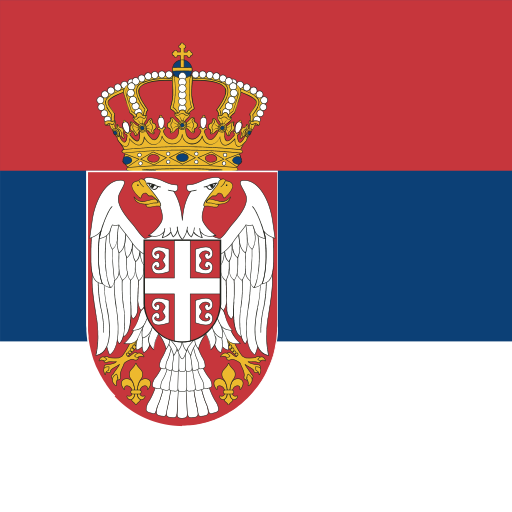
The championship also took Dila into the UEFA Champions League qualifying rounds for the first time. In the second qualifying round of the 2015/16 competition, the Georgian champions were drawn against Partizan Belgrade. Dila lost both legs, 0–1 in Belgrade and 0–2 in Gori, and therefore did not advance. Even so, the matches marked an important stage in the club's development and followed the strong European performances of the preceding years.
Dila has continued to compete for major honours in Georgian football. The club's second Georgian Cup triumph came in 2025, when Dila defeated Iberia 1999 3–1 in the final. The same year also brought the Georgian Super Cup, giving the club its first success in that competition. These later achievements added to the significance of the breakthrough period established in the previous decade.
The club's home is the Tengiz Burjanadze Stadium in Gori, named after the Georgian footballer Tengiz Burjanadze. Dila is traditionally associated with red and light blue, although the precise appearance of its playing kits has changed over time. The stadium has also hosted important matches involving the Georgian national team and domestic cup finals, making it one of the better-known football venues outside Tbilisi.
The history of Dila Gori is therefore defined less by continuous domination than by a series of breakthroughs. The first Georgian Cup in 2012, the memorable Europa League run in 2013 and the maiden league championship in 2015 established the club as a genuine challenger to Georgia's traditional football hierarchy. The cup and Super Cup successes of 2025 demonstrated that Dila's rise was not limited to a single generation, while its repeated appearances in European qualifying rounds have given the club an established place in the modern Georgian football landscape.