Coefficient:
14.000 2025/26
Ranking position:
35 2025/26
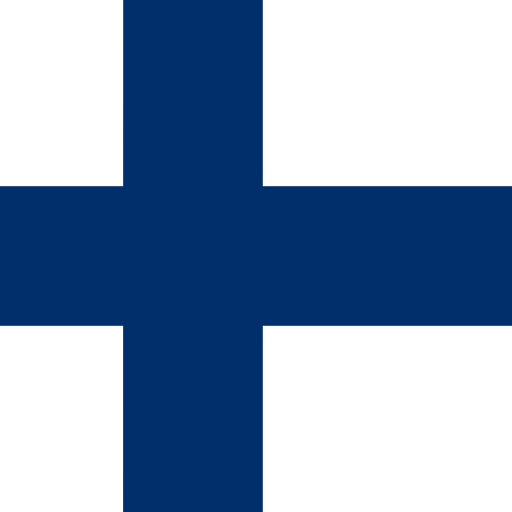 Finland
Finland has 4 representatives in European competitions in the 2026/27 season: KuPS, Inter Turku, Ilves Tampere, HJK thanks to its 38th place finish in the UEFA association coefficient ranking.
| 15 Oct 2026 | KuPS | 25% | 24% | 51% | Trabzonspor Kulübü | 2026/27 | Conference League | League phase – Matchday 1 | Head-to-head record and team comparison KuPS - Trabzonspor Kulübü |
| Country | 2022/23 | 2023/24 | 2024/25 | 2025/26 | 2026/27 | Total | Difference | |||
|---|---|---|---|---|---|---|---|---|---|---|
| 34 |
 |
Kosovo | 2.875 | 3.000 | 2.000 | 3.781 | 2.375 | 14.031 | -0.406 | Countries comparison: Finland - Kosovo |
| 35 |
 |
Bosnia and Herzegovina | 2.000 | 2.250 | 4.531 | 3.312 | 1.875 | 13.968 | -0.343 | Countries comparison: Finland - Bosnia and Herzegovina |
| 36 |
 |
Latvia | 2.750 | 1.625 | 3.875 | 2.000 | 3.625 | 13.875 | -0.250 | Countries comparison: Finland - Latvia |
| 37 |
|
Finland | 2.625 | 1.750 | 2.250 | 3.625 | 3.375 | 13.625 | – | |
| 38 |
 |
Kazakhstan | 1.125 | 3.125 | 3.000 | 3.625 | 1.500 | 12.375 | +1.250 | Countries comparison: Finland - Kazakhstan |
| 39 |
 |
Liechtenstein | 6.500 | 0.500 | 0.500 | 1.000 | 2.500 | 11.000 | +2.625 | Countries comparison: Finland - Liechtenstein |
| 40 |
 |
Moldova | 3.750 | 2.000 | 2.125 | 1.500 | 0.875 | 10.250 | +3.375 | Countries comparison: Finland - Moldova |
Finland is 1.250 points ahead of 38th place (Kazakhstan) and 0.250 points behind 36th place (Latvia).
| 2022/23 | 2023/24 | 2024/25 | 2025/26 | 2026/27 | Total |
|---|---|---|---|---|---|
| 2.625 | 1.750 | 2.250 | 3.625 | 3.375 | 14.000 |
Over the past five years, the country Finland has earned a total of 13.625 points in the UEFA competitions. Its best season was 2025/26, when it earned 3.625.
Finland belongs to the group of solid but still developing European football nations. In the UEFA country ranking, it currently sits around the end of the fourth decade, alongside countries such as Bosnia and Herzegovina and Kazakhstan. Its position is clearly stronger than that of many of the smallest federations, but Finland still needs more regular appearances by its clubs in the league phases of European competitions to move higher.
The country's main representatives are HJK Helsinki and KuPS Kuopio. In recent seasons, both clubs have accumulated similar numbers of UEFA ranking points, clearly ahead of Ilves Tampere, SJK Seinäjoki, Inter Turku and the other Finnish teams.
HJK Helsinki is Finland's most successful and best-known club. The team from the capital regularly competes for the national title, while its advantage over most domestic rivals comes from its larger budget, experience and more developed organisational structure.
HJK's greatest achievement in European competitions came in the 1998/99 season. The club eliminated French side FC Metz and became the first, and so far only, Finnish team to reach the Champions League group stage. In the group, HJK faced PSV Eindhoven, Kaiserslautern and Benfica.
HJK have never won a European trophy, but for many years they have been Finland's most regular representative in Europe. The club has repeatedly competed in qualifying rounds of the Champions League, Europa League and Conference League. This consistency makes HJK the most important source of ranking points for Finland.
The club's home is Bolt Arena in Helsinki. The stadium is located in the Töölö sports complex, close to other sporting facilities and recreational areas in the capital. Its relatively small size helps create an intimate atmosphere during matches, particularly in European qualifying rounds.
KuPS Kuopio has become HJK's most serious domestic challenger in recent seasons. The club from Kuopio, located in central Finland, regularly competes for the championship and takes part in European qualifying rounds.
KuPS has a similar UEFA ranking record to HJK, showing that Finnish football is not completely dominated by one club. The team has managed to progress through qualifying rounds and collect important points in the Conference League.
Kuopio is surrounded by lakes and forests, and the club has strong ties to the local community. For visiting European teams, travelling to this part of Finland means encountering very different conditions from those in Helsinki. The long journey, cooler climate and characteristics of Finnish pitches can provide an additional challenge.
The rivalry between HJK and KuPS is one of the highlights of the Finnish season. Both clubs have European ambitions, although their financial resources remain considerably smaller than those of teams from the stronger Scandinavian, Dutch or Belgian leagues.
Ilves Tampere is based in one of Finland's largest cities. In recent years, the club has begun appearing regularly in European qualifying rounds and has contributed points to the country's coefficient. Its development is important because Finland needs more teams capable of supporting HJK and KuPS.
SJK Seinäjoki represents the western part of the country. The club has won the Finnish championship and competed in European qualifying rounds, although its campaigns have generally been shorter than those of the leading pair.
Inter Turku has a long history and is one of the best-known clubs in south-western Finland. FC Honka, Haka Valkeakoski and VPS have also participated in European qualifying, but their contributions have been considerably smaller.
The Finnish league benefits from the wide geographical distribution of its clubs. Teams come from Helsinki, Tampere, Kuopio, Turku, Vaasa and other cities, meaning that football is not concentrated solely in the capital.
Finland has to develop football under particularly challenging climatic conditions. Winters are long, daylight hours are short, and northern parts of the country experience polar night during part of the year. Natural grass cannot form the basis of a year-round training system, so many clubs use artificial pitches and indoor facilities.
The domestic season is played mainly from spring to autumn. During European qualifying, Finnish clubs are usually already in competitive action, which can give them an advantage against teams from leagues whose seasons have only just begun or are still in pre-season.
Geography is also important. Finland is a vast country with a relatively low population density. Journeys between cities can be long, and away matches sometimes require air travel. Clubs from the north must plan their seasons with weather conditions, delays and limited transport connections in mind.
An interesting feature of many Finnish venues is their combination of football stadiums and wider sports centres. Football pitches, indoor halls, ice rinks and athletics facilities can often be found within the same complex. This reflects the country's strong multi-sport culture.
For a long time, Finland was one of the few European national teams yet to qualify for the finals of either the World Cup or the European Championship. The breakthrough came during the Euro 2020 qualifying campaign, when Finland qualified for a major tournament for the first time.
The team's leader was Teemu Pukki, who scored goals in the English Championship and Premier League. Lukas Hradecky, Glen Kamara, Tim Sparv and Joël Pohjanpalo also played important roles.
The qualification was hugely significant for Finnish supporters. Finland appeared at a tournament staged across several countries, while the victory over Denmark in Copenhagen became one of the most important moments in the history of Finnish football.
Earlier generations also produced outstanding players. Jari Litmanen spent many years as a star at Ajax and became one of the greatest Finnish footballers in history. He won the Champions League and became a symbol of Finland's technically gifted football tradition.
Finland is primarily associated with winter sports. Cross-country skiing, ski jumping, biathlon and ice hockey have deeper traditions in the country than football.
Football therefore competes for public attention with sports that are naturally suited to the Finnish climate. At the same time, the development of indoor facilities and artificial pitches has helped reduce the disadvantage compared with countries with milder weather.
Local clubs, youth development and widespread physical activity are important elements of Finnish sport. Children can participate in many different disciplines, while the best athletes have opportunities to progress into professional academies. This model also benefits football, although its effects tend to develop more slowly than in countries with a stronger football tradition.
Finland currently sits around the end of the fourth decade of the UEFA country ranking. Its advantage over Kazakhstan is significant, while it remains less than one point behind Bosnia and Herzegovina. This places Finland among a group of similarly ranked federations where positions can change considerably from season to season.
HJK Helsinki and KuPS Kuopio have collected the most points during the period analysed. Both clubs are positioned around the top 120 of the UEFA club ranking, while the next Finnish teams are considerably lower.
The biggest challenge is increasing the number of clubs capable of progressing through qualifying rounds. If Ilves, SJK or Inter Turku can join HJK and KuPS more regularly, Finland could improve its position.
Finland has never won a European trophy, but HJK reached the Champions League group stage and the national team qualified for the European Championship. For a country with a challenging climate and strong competition from ice hockey and winter sports, these are significant achievements.
Finnish football remains a developing sport in the shadow of larger sporting disciplines, but it has solid foundations: artificial pitches, well-organised clubs, experienced internationals and a growing pool of players capable of succeeding abroad. The biggest challenge will be turning these advantages into more consistent success for Finnish clubs in European competitions.
| Club | 2021/22 | 2022/23 | 2023/24 | 2024/25 | 2025/26 | Total | ||
|---|---|---|---|---|---|---|---|---|
| 117 |
|
HJK | 4.000 | 3.000 | 2.500 | 3.000 | 1.500 | 14.000 |
| 119 |
|
KuPS | 2.500 | 2.000 | 1.500 | 1.500 | 6.500 | 14.000 |
| 285 |
|
Ilves Tampere | 0.000 | 0.000 | 0.000 | 2.000 | 1.500 | 3.500 |
| 325 |
|
SJK Seinäjoki | 0.000 | 1.500 | 0.000 | 0.000 | 1.000 | 2.500 |
| 330 |
|
FC Honka | 1.500 | 0.000 | 1.000 | 0.000 | 0.000 | 2.500 |
| 336 |
|
Inter Turku | 1.000 | 1.000 | 0.000 | 0.000 | 0.000 | 2.000 |
| 411 |
|
FC Haka | 0.000 | 0.000 | 1.000 | 0.000 | 0.000 | 1.000 |
| 413 |
|
Vaasan Palloseura | 0.000 | 0.000 | 0.000 | 1.000 | 0.000 | 1.000 |
| Club | Elo | Chart | Last changes | ||||||||||||
|---|---|---|---|---|---|---|---|---|---|---|---|---|---|---|---|
| 1 |
|
Inter Turku | 1276 |
7 Oct 2026 0:0 vs IF Gnistan Veikkausliiga -2.66 |
18 Sep 2026 1:0 vs AC Oulu Veikkausliiga +5.31 |
14 Sep 2026 1:0 vs Vaasan Palloseura Veikkausliiga +4.27 |
9 Sep 2026 1:2 vs HJK Veikkausliiga -9.57 |
31 Aug 2026 1:0 vs KuPS Veikkausliiga +8.75 |
27 Aug 2026 1:4 vs FC Copenhagen Conference League Qualifications - Play-off -3.17 |
23 Aug 2026 0:0 vs Turun Palloseura Veikkausliiga -5.17 |
20 Aug 2026 0:0 vs FC Copenhagen Conference League Qualifications - Play-off +6.24 |
16 Aug 2026 3:2 vs AC Oulu Veikkausliiga +5.80 |
13 Aug 2026 2:2 vs FC Vaduz Conference League Qualifications - Round 3 +6.85 |
||
| 2 |
|
KuPS | 1261 |
8 Oct 2026 0:1 vs AC Oulu Veikkausliiga -17.09 |
19 Sep 2026 2:0 vs Vaasan Palloseura Veikkausliiga +6.84 |
13 Sep 2026 0:0 vs HJK Veikkausliiga -2.57 |
8 Sep 2026 1:1 vs IF Gnistan Veikkausliiga -3.02 |
31 Aug 2026 0:1 vs Inter Turku Veikkausliiga -8.75 |
27 Aug 2026 1:0 vs Shamrock Rovers Conference League Qualifications - Play-off +9.50 |
23 Aug 2026 2:4 vs IFK Mariehamn Veikkausliiga -18.37 |
20 Aug 2026 1:1 vs Shamrock Rovers Conference League Qualifications - Play-off +1.62 |
16 Aug 2026 2:1 vs FC Lahti Veikkausliiga +4.93 |
13 Aug 2026 1:2 vs CS Universitatea Craiova Europa League Qualifications - Round 3 -6.89 |
||
| 3 |
|
HJK | 1249 |
8 Oct 2026 6:0 vs Vaasan Palloseura Veikkausliiga +5.69 |
18 Sep 2026 1:1 vs IF Gnistan Veikkausliiga -1.81 |
13 Sep 2026 0:0 vs KuPS Veikkausliiga +2.57 |
9 Sep 2026 2:1 vs Inter Turku Veikkausliiga +9.57 |
31 Aug 2026 2:1 vs Ilves Tampere Veikkausliiga +9.79 |
23 Aug 2026 2:3 vs IF Gnistan Veikkausliiga -15.22 |
16 Aug 2026 3:0 vs FF Jaro Veikkausliiga +2.56 |
13 Aug 2026 0:2 vs Motherwell FC Conference League Qualifications - Round 3 -7.07 |
9 Aug 2026 1:0 vs AC Oulu Veikkausliiga +6.69 |
6 Aug 2026 1:1 vs Motherwell FC Conference League Qualifications - Round 3 +4.38 |
||
| 4 |
|
Ilves Tampere | 1164 |
19 Sep 2026 3:0 vs Turun Palloseura Veikkausliiga +7.79 |
12 Sep 2026 3:1 vs FC Lahti Veikkausliiga +5.98 |
8 Sep 2026 2:0 vs FF Jaro Veikkausliiga +3.59 |
31 Aug 2026 1:2 vs HJK Veikkausliiga -9.79 |
22 Aug 2026 0:1 vs Vaasan Palloseura Veikkausliiga -13.70 |
17 Aug 2026 2:3 vs IF Gnistan Veikkausliiga -10.98 |
13 Aug 2026 1:1 vs HNK Rijeka Conference League Qualifications - Round 3 +9.26 |
9 Aug 2026 2:0 vs IFK Mariehamn Veikkausliiga +2.95 |
6 Aug 2026 0:1 vs HNK Rijeka Conference League Qualifications - Round 3 -3.24 |
2 Aug 2026 0:1 vs AC Oulu Veikkausliiga -12.25 |
||
| 5 |
|
IF Gnistan | 1126 |
7 Oct 2026 0:0 vs Inter Turku Veikkausliiga +2.66 |
18 Sep 2026 1:1 vs HJK Veikkausliiga +1.81 |
12 Sep 2026 2:1 vs AC Oulu Veikkausliiga +9.83 |
8 Sep 2026 1:1 vs KuPS Veikkausliiga +3.02 |
31 Aug 2026 1:1 vs Turun Palloseura Veikkausliiga -4.03 |
23 Aug 2026 3:2 vs HJK Veikkausliiga +15.22 |
17 Aug 2026 3:2 vs Ilves Tampere Veikkausliiga +10.98 |
7 Aug 2026 2:2 vs SJK Seinäjoki Veikkausliiga +2.58 |
1 Aug 2026 0:1 vs KuPS Veikkausliiga -6.19 |
26 Jul 2026 2:1 vs Inter Turku Veikkausliiga +15.70 |
||
| 6 |
|
SJK Seinäjoki | 1097 |
9 Oct 2026 1:0 vs FC Lahti Veikkausliiga +7.24 |
18 Sep 2026 2:1 vs IFK Mariehamn Veikkausliiga +5.26 |
12 Sep 2026 1:1 vs FF Jaro Veikkausliiga -2.48 |
8 Sep 2026 0:0 vs Turun Palloseura Veikkausliiga +0.04 |
31 Aug 2026 0:0 vs AC Oulu Veikkausliiga +0.79 |
21 Aug 2026 1:2 vs FC Lahti Veikkausliiga -13.59 |
15 Aug 2026 0:2 vs IFK Mariehamn Veikkausliiga -13.64 |
7 Aug 2026 2:2 vs IF Gnistan Veikkausliiga -2.58 |
3 Aug 2026 3:0 vs HJK Veikkausliiga +12.28 |
24 Jul 2026 1:2 vs FF Jaro Veikkausliiga -12.56 |
||
| 7 |
|
Vaasan Palloseura | 1086 |
8 Oct 2026 0:6 vs HJK Veikkausliiga -5.69 |
19 Sep 2026 0:2 vs KuPS Veikkausliiga -6.84 |
14 Sep 2026 0:1 vs Inter Turku Veikkausliiga -4.27 |
8 Sep 2026 1:0 vs AC Oulu Veikkausliiga +7.14 |
31 Aug 2026 0:1 vs FC Lahti Veikkausliiga -13.47 |
22 Aug 2026 1:0 vs Ilves Tampere Veikkausliiga +13.70 |
14 Aug 2026 1:3 vs Turun Palloseura Veikkausliiga -14.41 |
8 Aug 2026 3:1 vs FF Jaro Veikkausliiga +8.00 |
2 Aug 2026 0:1 vs Inter Turku Veikkausliiga -8.02 |
25 Jul 2026 1:3 vs KuPS Veikkausliiga -3.99 |
||
| 8 |
|
AC Oulu | 1048 |
8 Oct 2026 1:0 vs KuPS Veikkausliiga +17.09 |
18 Sep 2026 0:1 vs Inter Turku Veikkausliiga -5.31 |
12 Sep 2026 1:2 vs IF Gnistan Veikkausliiga -9.83 |
8 Sep 2026 0:1 vs Vaasan Palloseura Veikkausliiga -7.14 |
31 Aug 2026 0:0 vs SJK Seinäjoki Veikkausliiga -0.79 |
22 Aug 2026 1:0 vs FF Jaro Veikkausliiga +9.30 |
16 Aug 2026 2:3 vs Inter Turku Veikkausliiga -5.80 |
9 Aug 2026 0:1 vs HJK Veikkausliiga -6.69 |
2 Aug 2026 1:0 vs Ilves Tampere Veikkausliiga +12.25 |
25 Jul 2026 1:1 vs IFK Mariehamn Veikkausliiga -1.64 |
||
| 9 |
|
FC Lahti | 1044 |
9 Oct 2026 0:1 vs SJK Seinäjoki Veikkausliiga -7.24 |
18 Sep 2026 1:1 vs FF Jaro Veikkausliiga -4.64 |
12 Sep 2026 1:3 vs Ilves Tampere Veikkausliiga -5.98 |
8 Sep 2026 2:1 vs IFK Mariehamn Veikkausliiga +5.81 |
31 Aug 2026 1:0 vs Vaasan Palloseura Veikkausliiga +13.47 |
21 Aug 2026 2:1 vs SJK Seinäjoki Veikkausliiga +13.59 |
16 Aug 2026 1:2 vs KuPS Veikkausliiga -4.93 |
9 Aug 2026 0:0 vs Inter Turku Veikkausliiga +6.96 |
1 Aug 2026 2:0 vs FF Jaro Veikkausliiga +7.14 |
26 Jul 2026 0:1 vs Ilves Tampere Veikkausliiga -4.63 |
||
| 10 |
|
Turun Palloseura | 997 |
10 Oct 2026 0:1 vs FF Jaro Veikkausliiga -13.43 |
19 Sep 2026 0:3 vs Ilves Tampere Veikkausliiga -7.79 |
12 Sep 2026 0:1 vs IFK Mariehamn Veikkausliiga -10.38 |
8 Sep 2026 0:0 vs SJK Seinäjoki Veikkausliiga -0.04 |
31 Aug 2026 1:1 vs IF Gnistan Veikkausliiga +4.03 |
23 Aug 2026 0:0 vs Inter Turku Veikkausliiga +5.17 |
14 Aug 2026 3:1 vs Vaasan Palloseura Veikkausliiga +14.41 |
9 Aug 2026 1:1 vs KuPS Veikkausliiga +7.83 |
1 Aug 2026 3:0 vs IFK Mariehamn Veikkausliiga +6.68 |
26 Jul 2026 0:1 vs HJK Veikkausliiga -3.10 |
||
| 11 |
|
IFK Mariehamn | 960 |
18 Sep 2026 1:2 vs SJK Seinäjoki Veikkausliiga -5.26 |
12 Sep 2026 1:0 vs Turun Palloseura Veikkausliiga +10.38 |
8 Sep 2026 1:2 vs FC Lahti Veikkausliiga -5.81 |
31 Aug 2026 2:0 vs FF Jaro Veikkausliiga +8.23 |
23 Aug 2026 4:2 vs KuPS Veikkausliiga +18.37 |
15 Aug 2026 2:0 vs SJK Seinäjoki Veikkausliiga +13.64 |
9 Aug 2026 0:2 vs Ilves Tampere Veikkausliiga -2.95 |
1 Aug 2026 0:3 vs Turun Palloseura Veikkausliiga -6.68 |
25 Jul 2026 1:1 vs AC Oulu Veikkausliiga +1.64 |
20 Jul 2026 0:2 vs FC Lahti Veikkausliiga -9.52 |
||
| 12 |
|
FF Jaro | 960 |
10 Oct 2026 1:0 vs Turun Palloseura Veikkausliiga +13.43 |
18 Sep 2026 1:1 vs FC Lahti Veikkausliiga +4.64 |
12 Sep 2026 1:1 vs SJK Seinäjoki Veikkausliiga +2.48 |
8 Sep 2026 0:2 vs Ilves Tampere Veikkausliiga -3.59 |
31 Aug 2026 0:2 vs IFK Mariehamn Veikkausliiga -8.23 |
22 Aug 2026 0:1 vs AC Oulu Veikkausliiga -9.30 |
16 Aug 2026 0:3 vs HJK Veikkausliiga -2.56 |
8 Aug 2026 1:3 vs Vaasan Palloseura Veikkausliiga -8.00 |
1 Aug 2026 0:2 vs FC Lahti Veikkausliiga -7.14 |
24 Jul 2026 2:1 vs SJK Seinäjoki Veikkausliiga +12.56 |
||