Coefficient:
13.989 2025/26
Ranking position:
36 2025/26
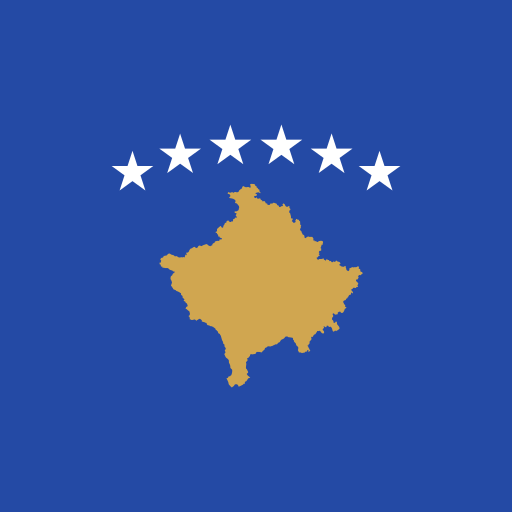 Kosovo
Kosovo has 4 representatives in European competitions in the 2026/27 season: Drita Gnjilane, Ballkani Suva Reka, FC Malisheva, Dukagjini Klina thanks to its 37th place finish in the UEFA association coefficient ranking.
| Country | 2022/23 | 2023/24 | 2024/25 | 2025/26 | 2026/27 | Total | Difference | |||
|---|---|---|---|---|---|---|---|---|---|---|
| 31 |
 |
Iceland | 3.000 | 3.833 | 4.562 | 3.625 | 2.000 | 17.020 | -2.989 | Countries comparison: Kosovo - Iceland |
| 32 |
 |
Ireland | 3.375 | 1.500 | 5.343 | 4.250 | 1.875 | 16.343 | -2.312 | Countries comparison: Kosovo - Ireland |
| 33 |
 |
Armenia | 2.375 | 2.250 | 4.375 | 4.187 | 2.625 | 15.812 | -1.781 | Countries comparison: Kosovo - Armenia |
| 34 |
|
Kosovo | 2.875 | 3.000 | 2.000 | 3.781 | 2.375 | 14.031 | – | |
| 35 |
 |
Bosnia and Herzegovina | 2.000 | 2.250 | 4.531 | 3.312 | 1.875 | 13.968 | +0.063 | Countries comparison: Kosovo - Bosnia and Herzegovina |
| 36 |
 |
Latvia | 2.750 | 1.625 | 3.875 | 2.000 | 3.625 | 13.875 | +0.156 | Countries comparison: Kosovo - Latvia |
| 37 |
 |
Finland | 2.625 | 1.750 | 2.250 | 3.625 | 3.375 | 13.625 | +0.406 | Countries comparison: Kosovo - Finland |
Kosovo is 0.063 points ahead of 35th place (Bosnia and Herzegovina) and 1.781 points behind 33rd place (Armenia).
| 2022/23 | 2023/24 | 2024/25 | 2025/26 | 2026/27 | Total |
|---|---|---|---|---|---|
| 2.875 | 3.000 | 2.000 | 3.781 | 2.375 | 13.989 |
Over the past five years, the country Kosovo has earned a total of 14.031 points in the UEFA competitions. Its best season was 2025/26, when it earned 3.781.
Kosovo is one of the youngest members of UEFA and FIFA, and its presence in international football has had a strong political dimension from the very beginning. In the UEFA country ranking, it currently sits around the middle of the fourth decade, alongside associations such as Estonia, Armenia, Latvia and Montenegro. For a country with such a short history of official international competition, this provides a starting point for further development, although Kosovan clubs still have to begin their European campaigns in the qualifying rounds.
Kosovo does not yet have a rich history in European competitions because its football association was unable to participate in official competitions for many years. Every progression to the next round is therefore not only a sporting achievement, but also part of the process of building the country's international standing.
Kosovo declared independence from Serbia in 2008. Serbia does not recognise the declaration and continues to regard Kosovo as part of its territory. Kosovo's independence is also not recognised by all European countries, including several members of the European Union. The dispute affects diplomacy, the economy, sport and the everyday lives of the population.
In football, the issue was particularly significant because UEFA and FIFA membership required a decision on whether the Kosovan football association could be recognised as representing an independent territory. For many years, Kosovo was unable to play official matches or enter clubs into European competitions. Players from Kosovo, however, represented Yugoslavia, Serbia, Albania, Switzerland, Germany and other national teams.
The situation began to change after Kosovo declared independence. The Kosovan Football Federation sought international recognition, and football became one of the most important tools in this campaign. Admission to UEFA meant that Kosovo would receive its own place within the European sporting structure.
In May 2016, Kosovo was admitted to UEFA as its 55th member. The decision followed a closely contested vote at the UEFA Congress in Budapest. A narrow majority of associations voted in favour, while Serbia strongly opposed the decision.
A few days later, Kosovo was also admitted to FIFA. This opened the way to participation in World Cup and European Championship qualifying campaigns and allowed Kosovan clubs to compete in European competitions. In practice, it marked the end of a long period of sporting isolation.
The Serbian Football Association attempted to challenge UEFA's decision before the Court of Arbitration for Sport. The appeal was rejected, however. The court ruled that Kosovo met the conditions for membership, including the requirement relating to recognition, as a majority of UN member states recognised its independence.
The dispute between Kosovo and Serbia is also visible in language, names and symbols. In Serbia, the term Kosovo and Metohija is often used, emphasising that Belgrade considers the region to be part of Serbia. In Kosovo, the dominant narrative is that of an independent state and its own national identity.
Matches involving the Kosovan national team are therefore more than ordinary sporting events. The flag, anthem, name of the federation and the ability to compete under their own designation all have state-building significance. For many residents, the Kosovan team is one of the most visible symbols of the country's international presence.
Politics also influences club relations. Some clubs in northern Kosovo, where the population is predominantly Serbian, do not recognise the institutions of the Republic of Kosovo and remain connected to the Serbian sporting system. This means that different sporting structures operate in parallel within the same territory, reflecting ethnic and political divisions.
Kosovo played its first official competitive match in the World Cup qualifiers in September 2016. The match against Finland ended in a draw, giving the newly recognised team its first point after gaining the right to participate in official competition.
Previously, the national team could only play unofficial matches under special arrangements established by FIFA. These games were important for the development of the team, but they were not treated in the same way as competitive qualifiers. The qualifying debut therefore marked the transition from sporting informality to full participation in international football.
An interesting feature of the Kosovan national team is the background of many of its players. Some were born outside Kosovo or grew up in Western Europe, particularly in Switzerland, Germany, Austria and Sweden. The diaspora has become one of the main sources of talent for the young national team.
The most important stadium in Kosovo is Fadil Vokrri Stadium in Pristina. The venue was previously known as the City Stadium, but it was renamed in honour of Fadil Vokrri, a prominent Kosovan footballer, administrator and president of the football federation.
Vokrri was one of the best-known footballers from Kosovo. He played for clubs including Partizan Belgrade and represented Yugoslavia. Later, he played a key role in the campaign for Kosovo's admission to UEFA and FIFA. His name therefore connects the history of football with the political process of gaining international recognition.
The stadium in Pristina was built during the Yugoslav era, but after Kosovo joined UEFA it underwent extensive modernisation. With support from UEFA's HatTrick programme, it was brought up to the standards required by international football. In 2018, it hosted Kosovo's first official home international match.
Before that, the Kosovan team had to play home matches outside the country, including in Shkodër, Albania. The return of the national team to Pristina was therefore an event of enormous symbolic importance.
The greatest achievement in Kosovan club football belongs to FC Ballkani. In the 2022/23 season, the club from Suharekë became the first Kosovan side to reach the group stage of a European competition. They achieved this in the Conference League, defeating teams including KÍ Klaksvík and Shkupi along the way.
Ballkani's qualification was a breakthrough for several reasons. First, it demonstrated that a Kosovan club could progress through several qualifying rounds. Second, it gave Kosovo its first appearance in the group stage of a European competition. Third, the achievement had considerable promotional value – the name of a club from a small city appeared in European media alongside much better-known teams.
Ballkani also recorded a famous away victory over Sivasspor. The Kosovan side won an exciting match in which they took the lead, surrendered their advantage and then scored the decisive goal late in the game. UEFA regarded the match as one of the most memorable moments of the club's debut European campaign.
Ballkani reached the group stage again the following season. This made them the first Kosovan team to reach that stage in two consecutive seasons. In later campaigns, similar achievements were also recorded by Drita, confirming the gradual development of Kosovan football.
Other important Kosovan clubs include Drita from Gjilan, FC Prishtina and Gjilani. Prishtina is the oldest and most recognisable football brand from the Kosovan capital, while Drita have earned valuable points in qualifying rounds and league phases in recent years.
The rivalry between clubs from Pristina and Gjilan has a particularly local character. Kosovan football is closely connected with local communities, and clubs often serve as representatives of specific cities and regions. League matches therefore have not only sporting significance, but also an important role in local identity.
Compared with Western European leagues, Kosovan clubs operate with smaller budgets and more modest infrastructure. Their advantage, however, lies in their ability to build teams around players familiar with the realities of Balkan football, as well as footballers returning from the diaspora.
Kosovo currently sits around the middle of the fourth decade of the UEFA country ranking. This position is an improvement compared with the first years of membership, but it still means that Kosovan clubs have to begin their European campaigns in the early qualifying rounds.
The country's coefficient is driven primarily by Drita and Ballkani. Drita are currently among the highest-ranked Kosovan clubs, while Ballkani remain the team that first broke through to the group stage. Prishtina have also earned points, although their contribution has been considerably smaller.
For Kosovo, every qualifying-round victory has a double significance. In addition to ranking points, it provides experience, revenue and greater visibility. Progression can also help clubs retain their best players and attract footballers from the Kosovan diaspora.
Kosovo have not won a European trophy, and their clubs are only beginning to build their history in UEFA competitions. The greatest achievements so far are Ballkani's qualification for the Conference League group stage and the subsequent campaigns of Drita and other Kosovan teams in the later qualifying rounds.
Kosovo's most important achievement, however, is not yet a particular trophy. It is the ability to compete under its own flag, host matches in its own stadium and face other national teams as a separate football association.
In Kosovo's case, football cannot be separated from politics. Membership of UEFA and FIFA was part of a broader struggle for international recognition, and every national team match is a reminder that the country's status remains disputed. At the same time, football helps create a shared identity among the population and gives the young state a space in which it can represent itself independently.
| Club | 2021/22 | 2022/23 | 2023/24 | 2024/25 | 2025/26 | Total | ||
|---|---|---|---|---|---|---|---|---|
| 120 |
|
Drita Gnjilane | 1.500 | 1.500 | 1.500 | 2.500 | 6.625 | 13.625 |
| 155 |
|
Ballkani Suva Reka | 0.000 | 3.000 | 3.000 | 2.000 | 2.000 | 10.000 |
| 292 |
|
Llapi Podujevo | 1.000 | 1.000 | 0.000 | 1.500 | 0.000 | 3.500 |
| 294 |
|
FC Prishtina | 2.000 | 0.000 | 0.000 | 0.000 | 1.500 | 3.500 |
| 355 |
|
SC Gjilani | 0.000 | 1.000 | 1.000 | 0.000 | 0.000 | 2.000 |
| 359 |
|
FC Malisheva | 0.000 | 0.000 | 0.000 | 1.000 | 1.000 | 2.000 |
| 386 |
|
Dukagjini Klina | 0.000 | 0.000 | 1.500 | 0.000 | 0.000 | 1.500 |
| Club | Elo | Chart | Last changes | ||||||||||||
|---|---|---|---|---|---|---|---|---|---|---|---|---|---|---|---|
| 1 |
|
Drita Gnjilane | 1137 |
9 Oct 2026 0:1 vs FC Malisheva Superleague -13.14 |
20 Sep 2026 2:1 vs Dukagjini Klina Superleague +8.99 |
13 Sep 2026 0:0 vs SC Gjilani Superleague -4.64 |
9 Sep 2026 0:1 vs FC Feronikeli 74 Superleague -16.28 |
5 Sep 2026 0:0 vs Drenica Srbica Superleague -6.32 |
30 Aug 2026 1:0 vs FC Vushtrria Superleague +4.82 |
27 Aug 2026 0:0 vs Inter Club d'Escaldes Conference League Qualifications - Play-off +2.34 |
20 Aug 2026 2:2 vs Inter Club d'Escaldes Conference League Qualifications - Play-off -0.32 |
16 Aug 2026 5:3 vs Llapi Podujevo Superleague +4.99 |
13 Aug 2026 5:0 vs SP Tre Fiori Conference League Qualifications - Round 3 +1.84 |
||
| 2 |
|
FC Malisheva | 1111 |
9 Oct 2026 1:0 vs Drita Gnjilane Superleague +13.14 |
19 Sep 2026 2:1 vs Ballkani Suva Reka Superleague +8.25 |
14 Sep 2026 4:0 vs Llapi Podujevo Superleague +11.82 |
10 Sep 2026 0:2 vs Dukagjini Klina Superleague -9.83 |
6 Sep 2026 3:1 vs SC Gjilani Superleague +6.87 |
29 Aug 2026 3:0 vs FC Feronikeli 74 Superleague +5.68 |
21 Aug 2026 1:1 vs Drenica Srbica Superleague -4.43 |
15 Aug 2026 6:1 vs FC Vushtrria Superleague +9.27 |
30 Jul 2026 1:4 vs Hibernian FC Conference League Qualifications - Round 2 -2.50 |
23 Jul 2026 2:0 vs Hibernian FC Conference League Qualifications - Round 2 +18.74 |
||
| 3 |
|
Ballkani Suva Reka | 1089 |
9 Oct 2026 1:0 vs Llapi Podujevo Superleague +8.75 |
19 Sep 2026 1:2 vs FC Malisheva Superleague -8.25 |
14 Sep 2026 0:0 vs Dukagjini Klina Superleague -3.00 |
9 Sep 2026 0:1 vs SC Gjilani Superleague -10.59 |
6 Sep 2026 2:0 vs FC Feronikeli 74 Superleague +2.87 |
28 Aug 2026 2:0 vs Drenica Srbica Superleague +8.52 |
22 Aug 2026 2:1 vs FC Vushtrria Superleague +4.07 |
16 Aug 2026 2:4 vs FC Prishtina Superleague -11.20 |
30 Jul 2026 3:2 vs Bohemian FC Conference League Qualifications - Round 2 +13.61 |
22 Jul 2026 1:2 vs Bohemian FC Conference League Qualifications - Round 2 -5.84 |
||
| 4 |
|
FC Prishtina | 1049 |
18 Sep 2026 2:1 vs SC Gjilani Superleague +11.69 |
13 Sep 2026 3:0 vs FC Feronikeli 74 Superleague +4.19 |
8 Sep 2026 4:1 vs Drenica Srbica Superleague +10.40 |
4 Sep 2026 1:0 vs FC Vushtrria Superleague +5.30 |
30 Aug 2026 4:0 vs Llapi Podujevo Superleague +10.44 |
16 Aug 2026 4:2 vs Ballkani Suva Reka Superleague +11.20 |
31 May 2026 1:2 vs Drenica Srbica Superleague -12.98 |
24 May 2026 2:1 vs Ballkani Suva Reka Superleague +14.43 |
17 May 2026 3:3 vs FC Ferizaj Superleague -3.02 |
6 May 2026 2:3 vs KF Prishtina e Re Superleague -12.84 |
||
| 5 |
|
Dukagjini Klina | 1037 |
20 Sep 2026 1:2 vs Drita Gnjilane Superleague -8.99 |
14 Sep 2026 0:0 vs Ballkani Suva Reka Superleague +3.00 |
10 Sep 2026 2:0 vs FC Malisheva Superleague +9.83 |
5 Sep 2026 2:1 vs Llapi Podujevo Superleague +11.03 |
29 Aug 2026 2:2 vs SC Gjilani Superleague +1.97 |
22 Aug 2026 1:0 vs FC Feronikeli 74 Superleague +4.45 |
15 Aug 2026 0:0 vs Drenica Srbica Superleague +0.55 |
29 Jul 2026 1:5 vs FC Lugano Conference League Qualifications - Round 2 -2.66 |
23 Jul 2026 0:1 vs FC Lugano Conference League Qualifications - Round 2 -1.18 |
31 May 2026 1:0 vs Ballkani Suva Reka Superleague +10.46 |
||
| 6 |
|
SC Gjilani | 1025 |
18 Sep 2026 1:2 vs FC Prishtina Superleague -11.69 |
13 Sep 2026 0:0 vs Drita Gnjilane Superleague +4.64 |
9 Sep 2026 1:0 vs Ballkani Suva Reka Superleague +10.59 |
6 Sep 2026 1:3 vs FC Malisheva Superleague -6.87 |
29 Aug 2026 2:2 vs Dukagjini Klina Superleague -1.97 |
23 Aug 2026 2:0 vs Llapi Podujevo Superleague +11.78 |
14 Aug 2026 3:1 vs FC Feronikeli 74 Superleague +7.63 |
31 May 2026 3:2 vs KF Prishtina e Re Superleague +4.48 |
24 May 2026 2:0 vs Drita Gnjilane Superleague +16.14 |
17 May 2026 1:2 vs Llapi Podujevo Superleague -11.90 |
||
| 7 |
|
Drenica Srbica | 986 |
20 Sep 2026 4:0 vs Llapi Podujevo Superleague +10.78 |
13 Sep 2026 3:0 vs FC Vushtrria Superleague +9.36 |
8 Sep 2026 1:4 vs FC Prishtina Superleague -10.40 |
5 Sep 2026 0:0 vs Drita Gnjilane Superleague +6.32 |
28 Aug 2026 0:2 vs Ballkani Suva Reka Superleague -8.52 |
21 Aug 2026 1:1 vs FC Malisheva Superleague +4.43 |
15 Aug 2026 0:0 vs Dukagjini Klina Superleague -0.55 |
31 May 2026 2:1 vs FC Prishtina Superleague +12.98 |
24 May 2026 3:2 vs FC Ferizaj Superleague +8.24 |
17 May 2026 1:4 vs FC Malisheva Superleague -6.27 |
||
| 8 |
|
Llapi Podujevo | 967 |
9 Oct 2026 0:1 vs Ballkani Suva Reka Superleague -8.75 |
20 Sep 2026 0:4 vs Drenica Srbica Superleague -10.78 |
14 Sep 2026 0:4 vs FC Malisheva Superleague -11.82 |
8 Sep 2026 4:0 vs FC Vushtrria Superleague +11.33 |
5 Sep 2026 1:2 vs Dukagjini Klina Superleague -11.03 |
30 Aug 2026 0:4 vs FC Prishtina Superleague -10.44 |
23 Aug 2026 0:2 vs SC Gjilani Superleague -11.78 |
16 Aug 2026 3:5 vs Drita Gnjilane Superleague -4.99 |
31 May 2026 3:2 vs FC Ferizaj Superleague +9.63 |
24 May 2026 3:2 vs FC Malisheva Superleague +9.29 |
||
| 9 |
|
FC Ferizaj | 934 |
31 May 2026 2:3 vs Llapi Podujevo Superleague -9.63 |
24 May 2026 2:3 vs Drenica Srbica Superleague -8.24 |
17 May 2026 3:3 vs FC Prishtina Superleague +3.02 |
10 May 2026 1:1 vs FC Malisheva Superleague +0.83 |
3 May 2026 1:1 vs SC Gjilani Superleague +3.89 |
30 Apr 2026 1:2 vs Dukagjini Klina Superleague -10.76 |
26 Apr 2026 0:3 vs Ballkani Suva Reka Superleague -4.66 |
18 Apr 2026 1:1 vs KF Prishtina e Re Superleague -4.29 |
12 Apr 2026 1:2 vs Drita Gnjilane Superleague -3.32 |
4 Apr 2026 0:1 vs Llapi Podujevo Superleague -7.99 |
||
| 10 |
|
FC Feronikeli 74 | 867 |
19 Sep 2026 3:1 vs FC Vushtrria Superleague +8.74 |
13 Sep 2026 0:3 vs FC Prishtina Superleague -4.19 |
9 Sep 2026 1:0 vs Drita Gnjilane Superleague +16.28 |
6 Sep 2026 0:2 vs Ballkani Suva Reka Superleague -2.87 |
29 Aug 2026 0:3 vs FC Malisheva Superleague -5.68 |
22 Aug 2026 0:1 vs Dukagjini Klina Superleague -4.45 |
14 Aug 2026 1:3 vs SC Gjilani Superleague -7.63 |
4 Aug 2026 +46.54 |
25 May 2025 1:4 vs Drita Gnjilane Superleague -2.10 |
17 May 2025 0:1 vs FC Prishtina Superleague -7.13 |
||
| 11 |
|
KF Prishtina e Re | 846 |
31 May 2026 2:3 vs SC Gjilani Superleague -4.48 |
24 May 2026 2:3 vs Dukagjini Klina Superleague -7.65 |
17 May 2026 2:3 vs Ballkani Suva Reka Superleague -3.09 |
6 May 2026 3:2 vs FC Prishtina Superleague +12.84 |
2 May 2026 0:1 vs Drita Gnjilane Superleague -3.47 |
29 Apr 2026 0:4 vs Llapi Podujevo Superleague -6.64 |
25 Apr 2026 2:3 vs Drenica Srbica Superleague -10.20 |
18 Apr 2026 1:1 vs FC Ferizaj Superleague +4.29 |
11 Apr 2026 2:1 vs FC Malisheva Superleague +12.63 |
4 Apr 2026 1:2 vs SC Gjilani Superleague -6.72 |
||